

My Books
Ghost of a Phantom
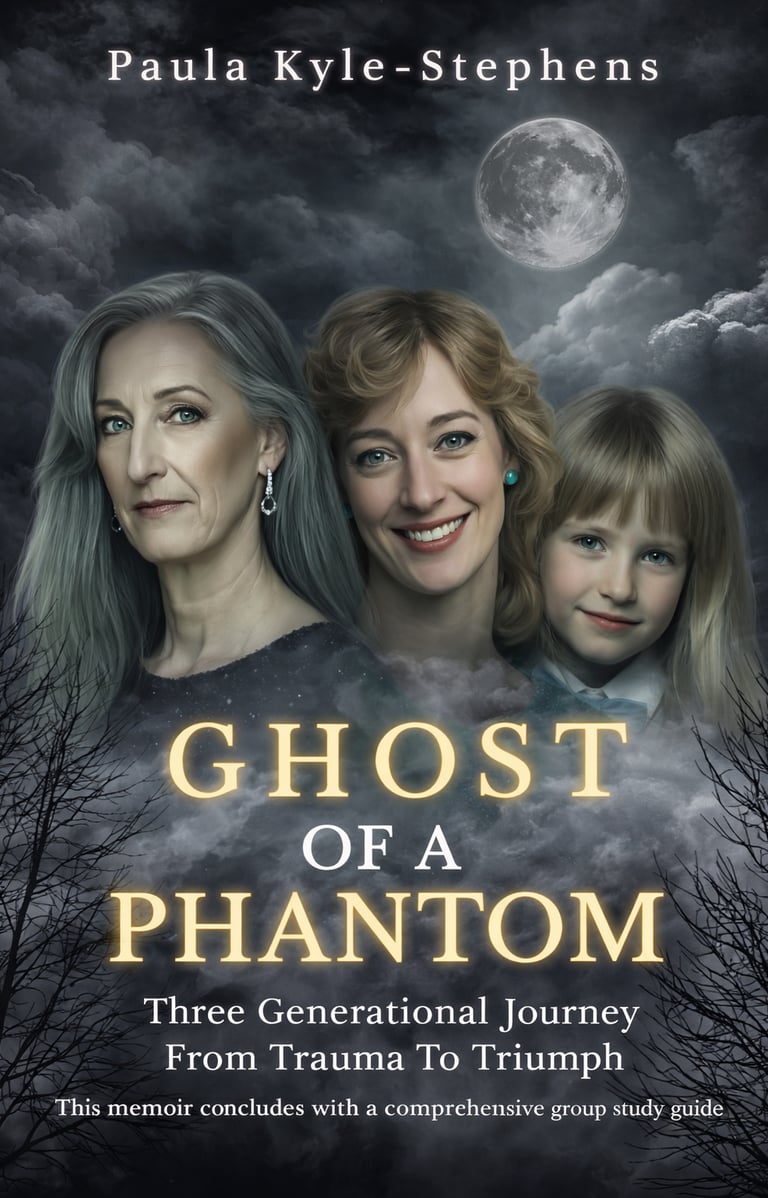

Journey Through Trauma
Ghost of a Phantom is a powerful, deeply personal memoir chronicling Paula’s journey from a turbulent childhood in a military family, through the trauma of loss, abuse, and the foster care system, to eventual healing, advocacy, and hope.
The story begins with Paula’s early years as the eldest daughter in a large, blended military family, marked by frequent relocations and the shadow of her father’s service in Vietnam. The sudden, mysterious death of her mother while living overseas shatters the family, leading to Paula and her siblings being separated and placed in different foster homes upon their return to Ohio. This moment of rupture—being handed a small paper bag of belongings and torn from her sisters—becomes the defining trauma of her childhood.
Paula’s experiences in foster care are harrowing she is uprooted seven times in a single year, faces neglect and abuse in several homes, and endures the pain of being stigmatized and bullied at school. The memoir does not shy away from the darkness—detailing the cruelty of her stepmother, the indifference of some foster parents, and the emotional toll of being labeled and misunderstood. Yet, it is also a testament to resilience: Paula clings to hope, music, faith, and the memory of her siblings as lifelines.
A turning point comes when Paula is placed with Larry and Bonnie Ulrey, foster parents whose compassion, wisdom, and unwavering support become a roadmap for healing. Through their gentle guidance, she learns the power of forgiveness, the importance of self-worth, and the value of belonging. The Ulrey’s never refer to her as a “foster child,” but as “daughter number two,” offering her the unconditional love, and stability for which she has longed. Their home becomes a sanctuary, and their lessons—on everything from saving money to setting the dinner table—become the foundation for Paula’s recovery and growth.
The memoir explores the long-term effects of trauma, including Paula’s struggles with PTSD, trust, and relationships as an adult. It follows her journey through young motherhood, marriage, divorce, and the challenges of raising her own children while still haunted by the ghosts of her past. Paula’s path is not linear—she faces setbacks, breakdowns, and moments of despair—but she also finds moments of profound healing, especially through her work as an advocate, mentor, and trainer for foster youth and parents.
Interwoven throughout the narrative are stories of reunion and loss: reconnecting with her siblings after decades apart, grieving the deaths of loved ones, and finding closure in unexpected places. The memoir is also a tribute to the unsung heroes of the foster care system—caseworkers, teachers, and especially foster parents like Larry and Bonnie—whose kindness and commitment can change the trajectory of a child’s life.
Paula’s voice is honest, vulnerable, and at times, poetic. She invites readers into the labyrinth of her memories, sharing not only the pain and confusion but also the small miracles and moments of hope that sustained her. The memoir closes with a message of empowerment: that healing is possible, that knowledge and compassion can break cycles of trauma, and that every child deserves to feel wanted and loved.
Ghost of a Phantom is more than a survivor’s tale it is a call to action for foster parents, social workers, educators, and anyone who cares about the welfare of children. It is a testament to the enduring strength of the human spirit and the transformative power of love, belonging, and hope.
This Memoir has a Companion Trauma Workbook
Triumph and Hope
A Three Generational Journey From Trauma To Triumph
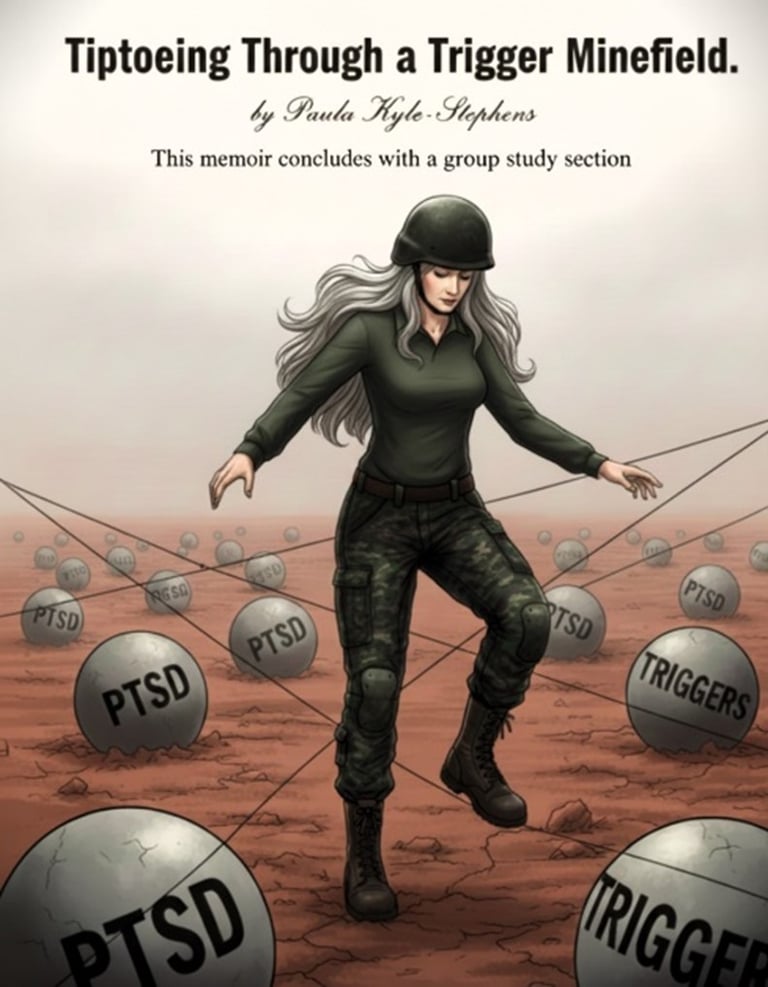
What Tiptoeing Through a Trigger Minefield
What Tiptoeing Through a Trigger Minefield Is — and Why It Exists
Tiptoeing Through A Trigger Minefield exists because too many people live inside trauma responses without ever being told the truth about what they are experiencing. It was written to name what has long gone unnamed—to give language, structure, and context to reactions that have been misunderstood, misdiagnosed, and blamed on character rather than recognized as survival.
At its core, this book is about how a nervous system adapts when danger is not an event, but an environment. It traces how repeated exposure to fear, coercion, betrayal, and powerlessness—especially in childhood—plants an internal minefield where the body learns to anticipate harm long after the original danger has passed. These mines are not memories alone; they are reflexes, sensations, shutdowns, and alarms that activate in ordinary moments, confusing both the person experiencing them and the people around them.
The memoir was brought to light because the author lived most of her life walking through this minefield without a map.
From early childhood, the author was shaped by prolonged, relational trauma rather than a single catastrophic event. Her home was dominated by constant interrogation, psychological warfare, and fear—conditions that taught vigilance, silence, and self-erasure as necessities. Central to this environment was her mother, a woman subjected to relentless coercive pressure to confess to something that did not happen. The interrogation did not pause. It did not resolve. It did not allow for rest or safety.
In order to endure this unrelenting psychological assault—and to prevent her children from growing up watching the full, raw brutality of her treatment—the author’s mother turned to medication as a means of endurance, not escape. Her substance use is not presented as addiction in the moral or pathological sense, and it is not portrayed as the cause of her death. It is framed as a last-ditch survival strategy: a way to remain standing, to function, and to shield her children from constant exposure to terror.
The memoir is explicit and careful on this point: the author’s mother did not die from addiction. Her death was sudden, unexplained, and remains unresolved. No definitive cause was ever established, and the circumstances surrounding her death were never fully brought to light. What followed was not truth, but narrative—one imposed on the children, in which blame was assigned where it did not belong and reality was overwritten by convenience. This unresolved loss, and the false responsibility placed on the children afterward, became one of the deepest mines in the author’s internal landscape.
As the book unfolds, it becomes clear that the trauma did not end with childhood. Foster care separation, the fracturing of sisterhood, institutional failure, medical betrayal, coercion, adult violence, and later-life losses all collide with a nervous system already trained to survive. Each new trauma does not stand alone—it detonates earlier ones, explaining why reactions intensify rather than fade, and why “moving on” is not a simple act of will.
A central figure throughout the memoir is what the author calls the Phantom—her name for the embodied presence of Complex PTSD. The Phantom is not portrayed as an enemy, but as a once-necessary protector: the part of the nervous system that learned to stay alert, anticipate danger, and act quickly to prevent harm. For decades, this Phantom ran the show, hijacking reactions, relationships, and self-perception—because no one ever explained what it was.
That silence is one of the primary reasons this book was written.
Despite decades in therapy, the author was never taught what PTSD was, what Complex PTSD was, or what triggers actually are. She was never given language for why the past kept showing up in the present, or why her body reacted before her mind could catch up. Without that knowledge, she—like so many others—assumed the problem was personal failure rather than biological learning.
Tiptoeing Through A Trigger Minefield exists to correct that injustice.
The book weaves personal narrative with trauma-informed explanation to show that hypervigilance, freeze, fawn, silence, appeasement, shutdown, and anticipatory fear are not flaws. They are coherent, intelligent adaptations formed under conditions where safety was unreliable and power was misused. The memoir insists that survival is not pathology—and that healing does not begin with exposure, confession, or “fixing,” but with understanding.
Equally important, the book challenges how trauma is interpreted in families, systems, therapy, and culture. It addresses sibling trauma, the generational transmission of vigilance, and how children are often blamed for the damage done to them. It calls out institutional failures—not with spectacle, but with clarity—arguing that education is not optional in trauma care. People deserve to know what is happening in their bodies before they are asked to interpret their lives.
Ultimately, Tiptoeing Through A Trigger Minefield is not about erasing the past or becoming fearless. It is about reclaiming reality. It is about naming what happened accurately, returning responsibility to where it belongs, and learning to walk through the internal landscape with awareness instead of self-blame.
The book was brought to light because silence kept too many people trapped—walking carefully without knowing why, apologizing for reactions that once kept them alive. This memoir offers what the author was denied for most of her life: a map, a language, and permission to stop treating survival as something shameful.
The final truth the book leaves the reader with is simple and hard-earned:
You are not broken.
You were paying attention.
And understanding the minefield does not trap you in it—it shows you where you are, and where you are not anymore.
This memoir has a companion trauma workbook
Leftovers
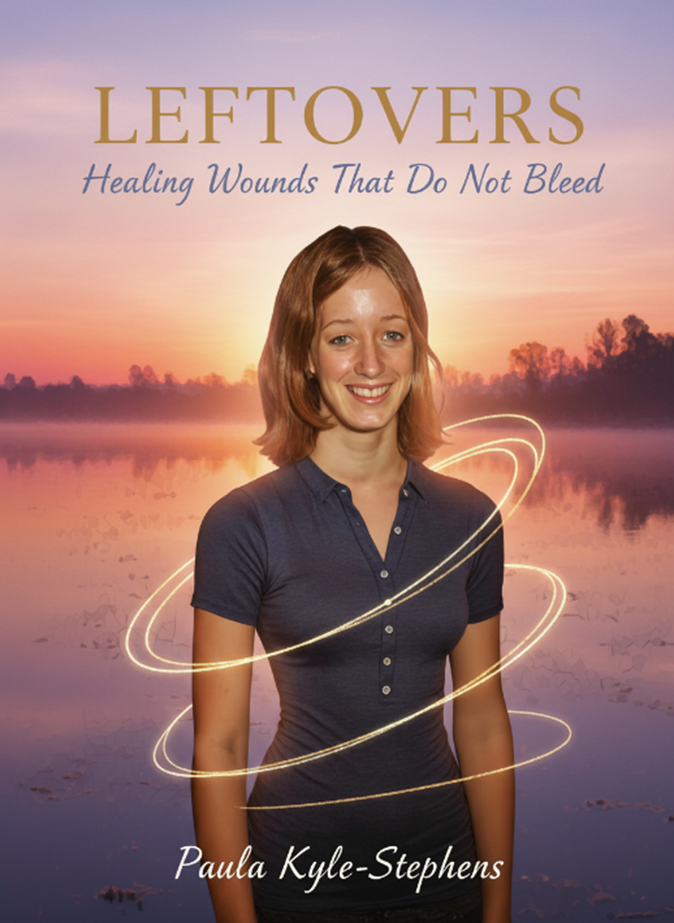

Journey Through Trauma
A Memoir
Leftovers – Healing Wounds That Do Not Bleed is a raw, unflinching memoir about the kind of trauma that leaves no visible scars yet quietly shapes an entire life. It tells the story of a woman who grew up inside generational trauma, psychological warfare, foster care, and systemic silence—and who lived for decades carrying the “leftovers” of experiences she could not yet name.
This memoir centers on Complex PTSD (C‑PTSD) long before the diagnosis was widely understood. Rather than presenting trauma as a single event, Leftovers exposes trauma as an accumulation: years of fear, interrogation, gaslighting, abandonment, and survival that alter the nervous system, identity, and body itself. The wounds do not bleed, but they echo—through memory, behavior, health crises, relationships, and self‑perception.
The book traces the author’s childhood in a military household marked by control, fear, and psychological domination, followed by abrupt separation from siblings and placement into foster care. What follows is a lifetime of unanswered questions, misdiagnoses, and repeated emotional crises that never made sense—until much later. The memoir captures the experience of living in constant survival mode while appearing functional, responsible, and capable to the outside world.
A central thread of Leftovers is the devastating power of lies, labels, and silence. The author explores how false narratives—spoken by authority figures, institutions, and family members—can fracture identity and poison self‑worth. She reveals how children absorb blame for what was done to them, and how those beliefs quietly follow them into adulthood.
The memoir also documents the physical cost of unresolved trauma. Recurrent medical emergencies, surgeries, and unexplained health crises run parallel to emotional triggers, demonstrating how trauma embeds itself in the body when it has nowhere else to go. The author’s eventual diagnosis of Complex PTSD becomes a turning point—not a cure, but a framework that finally makes the past intelligible.
Interwoven throughout the narrative are moments of unexpected grace: foster parents who provided safety, mentors who believed in the author’s voice, and healing environments that offered brief refuge from chaos. These moments do not erase the damage, but they interrupt it proving that compassion can coexist with cruelty, and that survival does not happen alone.
As the memoir progresses, Leftovers shifts from confusion to clarity. The author begins to understand triggers, trauma responses, and the long‑term effects of living under constant threat. She names what had once been invisible and begins reclaiming agency over her mind and body. Education becomes a form of power; understanding trauma becomes the first step toward freedom.
Ultimately, Leftovers – Healing Wounds That Do Not Bleed is not just a personal story, but a testimony for those who have spent their lives wondering why they are “too much,” “too sensitive,” or “never fully okay.” It gives language to survivors whose pain was minimized, misunderstood, or misdiagnosed—and validates the reality that some wounds are inherited, invisible, and deeply real.
This memoir is for survivors of childhood trauma, foster care, domestic psychological abuse, and Complex PTSD. It is for those who have done everything “right” and still felt broken. Most of all, it is for anyone carrying the leftovers of a past that never properly ended and who needs to know that healing begins with truth.
This Memoir has a Companion Trauma Workbook
Triumph and Hope
Healing Wounds That Do Not Bleed


Reclaiming Her
Reclaiming Her – A Woman’s Way Back to Herself
A Memoir
Reclaiming Her – A Woman’s Way Back to Herself is a deeply embodied memoir about what happens after survival—after the trauma has been named, after the patterns have been recognized, and after a woman realizes that understanding her wounds is different from living freely inside herself.
This book is not about recounting trauma in detail. It is about returning to the body, to the voice, to rest, to boundaries, to intuition, and to identity. It chronicles the author’s lived journey of moving out of survival mode and into conscious inhabitation of her own life.
The memoir opens with the truth that many women quietly carry some were wounded before identity had time to form. For these women, healing is not a return to a former self, because there was never a safe “before.” Instead, Reclaiming Her explores what it means to build identity forward—not through force or fixing, but through safety, presence, and choice.
Structured as a blend of personal narrative, reflection, and trauma-informed wisdom, the book traces the author’s reconnection with her body after years of disconnection. She learns to listen to physical signals once ignored—fatigue, tension, hunger, restlessness—not as weaknesses, but as communication. Nature becomes a central companion in this return, offering stillness, symbolism, and rhythm that mirror the author’s gradual softening back into herself.
As the memoir unfolds, the reader follows the author through pivotal reclamation points: nourishing the body without punishment, redefining movement as medicine rather than discipline, and understanding how trauma lives not only in memory but in muscles, breath, and posture. The book emphasizes that healing does not happen through intensity, exposure, or relentless effort, but through gentle consistency and nervous system safety.
A core theme of Reclaiming Her is boundaries—learning to say no without collapse, guilt, or explanation. The author examines how women are conditioned to carry emotional labor, absorb stress, and disappear for the comfort of others, and how reclaiming selfhood requires becoming someone who decides. Boundaries are presented not as rejection, but as protection and self-respect.
The memoir also moves inward, addressing inherited beliefs, generational scripts, and the inner voices that were shaped by survival rather than truth. Through compassionate self-inquiry and inner-child work, the author begins repairing the places that froze in childhood, offering the younger self what was once missing: safety, validation, and presence.
Rest emerges as a sacred and radical act. In a culture that glorifies exhaustion, Reclaiming Her reframes stillness as medicine and rest as resistance. The author documents her shift from burnout and overextension into a life structured around sustainability, ritual, and alignment—where care is no longer something earned, but something assumed.
As the memoir moves toward its conclusion, it widens beyond the self to include community, voice, and purpose. The author reflects on the power of women gathering, storytelling, mentorship, and shared healing. Owning one’s voice becomes not only personal liberation, but an offering—proof that survival can be transformed into wholeness.
Ultimately, Reclaiming Her – A Woman’s Way Back to Herself is about becoming—not despite what was endured, but because safety has finally made space for choice. It affirms that a woman is not late to her life when she begins again; she is arriving exactly when she is ready to live from her center.
This memoir is for women who feel fragmented, exhausted, or disconnected—not because they are broken, but because they spent years surviving. It offers a grounded, compassionate path back into the body, back into truth, and back into a life that no longer requires self-abandonment.
Reclaiming Her is not the end of a healing journey.
It is the moment the story finally belongs to the woman living it.
A Woman’s Way Back to Herself
Footprints in the Paradise Forest
A Collection of Brave Days and Borrowed Cowbot Hats


Footprints in the Paradise Forest: A Collection of Brave Days and Borrowed Cowboy Hats is a deeply moving and often humorous memoir about what happens when people, especially children—are given space instead of pressure, presence instead of instruction, and animals instead of answers.
Set at Paradise in the Sky, a nature‑based, equine‑centered sanctuary Co-Founded as a 501c3 Non-Profit by author Paula Kyle‑Stephens, the book weaves together true stories of children, families, volunteers, and animals whose lives intersect in a quiet stretch of woods where healing is never forced—and courage is allowed to emerge on its own terms.
This is not a book about fixing people. It is about making room.
Across vivid, story‑driven chapters, readers meet foster children discovering confidence beside miniature horses, teens learning patience by sharing animals and space, adults releasing long‑held grief through breath and stillness, and individuals with profound disabilities experiencing connection without barriers. Horses, donkeys, and dogs are not symbols or metaphors here—they are active participants: listeners, teachers, protectors, and mirrors who respond not to words, but to truth.
From a joyful, braying miniature donkey who leads children into laughter, to a massive draft horse who instinctively lowers her head to meet motionless hands, each animal meets people exactly where they are. In doing so, they help reveal something essential: bravery doesn’t roar. It whispers. It waits. And it often shows up wearing muddy boots and a borrowed cowboy hat.
Interwoven with these encounters are reflections from the author’s own life—on foster care, loss, disability, belonging, and the long shadows trauma can cast. Through these experiences, Footprints in the Paradise Forest explores how nature and animals communicate in ways humans often forget, and how healing can happen without therapy language, diagnoses, or timelines.
At its core, this memoir is about the footprints we leave behind—not just in soil and forest paths, but in memory. The kind that lingers long after a day ends. The kind that quietly changes how a child sees themselves, or how an adult remembers what gentleness feels like.
Written with warmth, humor, reverence, and emotional honesty, Footprints in the Paradise Forest invites readers to slow down, listen closely, and believe—just a little that places can hold stories, animals can meet us where we are, and sometimes the most important journeys happen at a walking pace.
Footprints in the Paradise Forest has a companion Workbook for TEENS